You Don’t Need a New Tool, You Need a New Perspective.
Clouds are sparse, wind is nonexistent, and the humidity is palpable. I step out of my truck and immediately squint against the bright summer sun. I walk around to the back seat and open the door. First, I unbuckle him and then I grab my son under the armpits, making a dramatic whooshing noise as I hoist him out of the car seat. The sound is an amalgamation of airplane, rocket ship, and race car—what I call a “dad noise”.
He would rather be carried, and I prefer having both hands free at the hardware store, so we compromise. He rides on my shoulders. As we cross the parking lot, I can feel both of us cooking in the heat. This is the second hardware store I've visited today, and I'm determined to find what I need.
The Search for the Perfect Tool
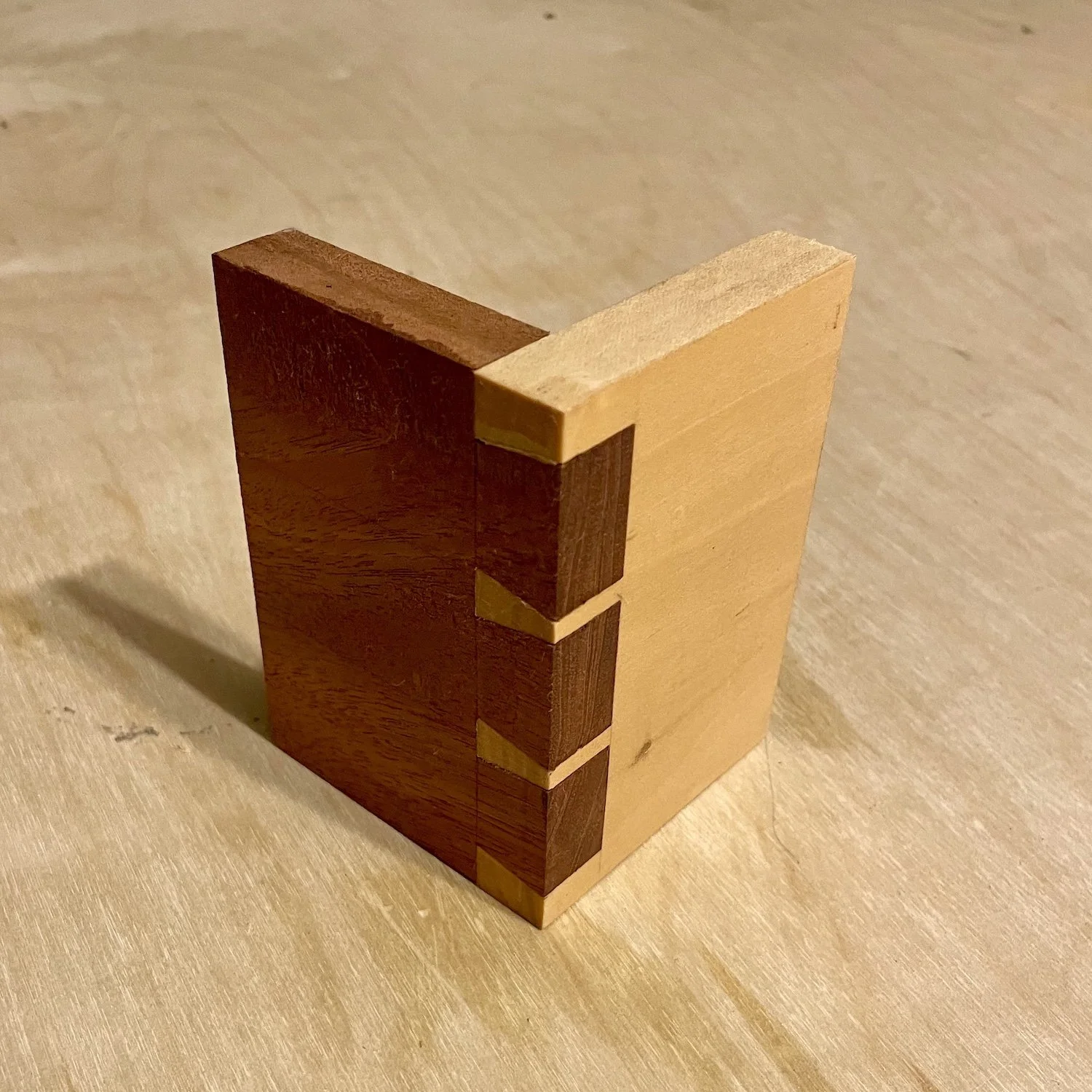
Hand-cut dovetails from the shop. The tails are the dark wood and the pins are the light. These are through dovetails.
Lately, I've been cutting a lot of dovetails in the shop. All by hand. It’s the only kind I use.
If you're unfamiliar with dovetails, they're one of the strongest and most enduring woodworking joints ever developed. They're commonly used in drawers, cabinets, bookcases, and boxes—anywhere two pieces of wood meet at a corner.
Archaeologists have found dovetail joints in ancient Egyptian furniture, Chinese tombs, and centuries-old temples in India.
They're strong, beautiful, and deeply tied to the traditions of fine woodworking. Learning to cut dovetails well is a rite of passage for any serious woodworker. The joint embodies everything I love about heirloom furniture: patience, craftsmanship, and attention to detail.
A good dovetail joint fits snugly. Too tight, and the pin board can split during assembly. Too loose, and gaps distract from the beauty of the piece. Because I'm cutting dozens of dovetails for a current project, anything that helps standardize the process is worth considering.
So I went looking for a file.
Not just any file, but a tapered triangular file that could reach into the corners of the pins and tails and help me refine the fit. I already use chisels for this work, and they do the job well. But chisels require careful attention to grain direction and a light touch. I thought a specialized file might speed things up while maintaining accuracy.
Two Hardware Stores and No Solution
Armed with that idea, I visited my local hardware store.
And I mean local.
The kind of old-fashioned hardware store that's becoming increasingly rare. It's dimly lit, a little musty, and the owner is the only person who works there. He's a cranky-looking but genuinely kind old man who peers at us over wire-rimmed glasses and asks: "Can I help you boys?"
I smile and explain what I'm looking for and where I expect to find it.
"Right you are," he says with a nod before returning to the register.
A few minutes later, I realize the trip is fruitless. There are plenty of files, but they're all wrong. This one is too large. That one is too small. These are too coarse. Those are too fine. The Goldilocks file I'm searching for simply isn't there.
My son and I head back to the truck and I make the unthinkable decision to visit a big-box home improvement store.
A few minutes after arriving in the correct aisle, I realize this store doesn't have what I need either. Giving up and driving home empty-handed feels like failure, so I spend several minutes studying options I already know won't work while my son explores the lower shelves. He is only looking, but he’s three, so he looks with his hands.
"Careful, that one's heavy, buddy."
"Yeah, we have one like that at home!"
"Stay close. Daddy's almost done."
He's having a wonderful time. I am not.
Eventually, I admit defeat and begin putting away the collection he's accumulated: a hammer, a pair of pliers, a screwdriver, a dangerously-impractical chisel-file combination, and a box cutter (it’s packaged, don’t worry). As we leave, he reminds me that he's supposed to be riding on my shoulders.
You Don’t Need Another New Tool
Walking out of the store, my son asks in his tiny toddler voice, "Did you not find what you need, Dad?”
I’m about to answer, ”No, son. I did not find what I need."
But before the words come out, my mind jumps back to the shop. I have a bin full of triangular offcuts from a project last year.
A piece of wood.
A strip of fine-grit sandpaper.
That's all I need.
I'll wrap the sandpaper around the offcut and use it exactly where the file would have gone. A custom sanding stick. A homemade file. Problem solved. I delight in my own genius, revel in my creative thriftiness and rue the fact that it took two trips and an hour of my time to end up back where I started.
In an instant, I go from frustrated to amused. I spent an hour searching for a tool when the solution was already sitting in my shop. Life is full of moments like this.
Too often we look for a shortcut, a simple trick or a new tool to solve the problem. Sometimes it will. And using good tools matters. But just as often, the answer isn't buying something new—it's looking at the problem differently.
Many of the best woodworking solutions come from understanding the material, adapting what you already have, and thinking creatively. That's true in woodworking. And it's probably true in life, too.
I smile and answer my son's question.
"Yes," I say. "Sometimes buddy, you don't need a new tool. You just need a new perspective."